From Complexity to Control: Scalable Micro Metal Production with Metal 3D Printing
Conventional micro metal manufacturing requires many sequential steps, each adding variation and cost. Sinter-based additive manufacturing consolidates these into a single digital process. This article shows how complexity reduction translates directly into scalable, stable production.
As micro metal components become smaller, more detailed, and demand more functional integration, manufacturing workflows become increasingly complex. Conventional production methods require multiple machines, process steps, and often multiple suppliers to produce fine features and integrated functionality. This fragmentation increases handling, coordination, and process variation, leading to higher cost, longer lead times, and greater quality risk.
For companies producing or purchasing high-accuracy micro metal parts at scale, this growing complexity is not just an operational inconvenience. It becomes a structural barrier to stable, repeatable, and scalable manufacturing.
Metal 3D printing offers a fundamentally different approach. By consolidating multiple manufacturing steps into a single digital workflow, additive manufacturing reduces complexity, lowers risk, and enables scalable production.
Among these technologies, particularly sinter-based additive manufacturing technologies offer a significant opportunity because they combine high design freedom with industrial scalability, enabling the integration of complex features while maintaining process stability and cost efficiency. Lithography-based Metal Manufacturing (LMM) is especially well suited for complex micro metal components.
In multi-step manufacturing chains, each process introduces its own dimensional tolerance. While every individual step may meet its specification, the cumulative variation across the chain can result in measurable deviation in the final component. This phenomenon, known as tolerance stack-up, becomes particularly critical for micro metal parts where tight tolerances and functional precision are essential.
Managing complexity becomes as important as managing geometry.
Conventional manufacturing often requires coordination across multiple process steps, machines, operators, and sometimes suppliers. Each additional step introduces interfaces that must be managed, which can increase variability, lead times, and planning complexity.
By consolidating manufacturing into a unified digital process, sinter-based metal additive manufacturing enables:
- Stable dimensional accuracy across batches
- Reduced manual intervention
- Predictable and simplified production planning
- Reduced supply chain complexity
- Improved repeatability and process stability
Because multiple micro components can be produced simultaneously in controlled production batches, scaling from prototype to serial production becomes significantly more efficient. Metal 3D printing is not only a prototyping tool. It is a viable solution for serial manufacturing when complexity management and process stability are critical.
Beyond technical simplification, manufacturing consolidation has measurable economic impact. Each additional process step introduces not only variation but also operational overhead in setup, labor allocation, coordination, logistics, and inspection.
By reducing process interfaces, additive manufacturing lowers total operational exposure across the value chain. The result is not merely fewer steps, but:
- Reduced cumulative overhead cost
- Shorter planning and throughput times
- Lower coordination effort across suppliers or departments
- Reduced systemic risk from process interruptions
- Improved production predictability
In this context, complexity reduction translates directly into economic stability. Simplifying manufacturing is one of the most effective strategies for improving both economic efficiency and product quality. The use of AM enables design flexibility and freedom to change without complex machine setup allowing more freedom in manufacturing.
Adopting metal 3D printing does not require abandoning established production methods. Instead, companies can validate additive manufacturing in a structured evaluation process.
This validation confirms whether additive manufacturing can achieve:
- Equivalent or improved dimensional accuracy
- Equivalent or improved functional performance
- Reduced manufacturing complexity
- Improved scalability and stability
- Greater design freedom, enabling geometries that are difficult or impossible to realize with conventional manufacturing
If conventional manufacturing remains optimal, validation provides clarity. If additive manufacturing offers advantages, the result can include significant improvements in cost, risk reduction, and production scalability. This approach ensures manufacturing optimization with minimal risk.
In conventional manufacturing, prototype production methods often differ from serial production methods, requiring redesign, tooling adjustments, or process changes during scale-up.
Sinter-based metal additive manufacturing, including LMM, enables both prototype and serial production using the same core process. This continuity:
- Accelerates development cycles
- Eliminates transition risk
- Ensures consistent dimensional behavior
- Improves long-term production stability
For complex micro metal parts, this consistency across the product lifecycle is a significant competitive advantage.
As micro metal components become more complex and production volumes increase, manufacturing simplicity becomes a strategic necessity. Metal 3D printing, particularly sinter-based technologies, provides a general solution to reduce manufacturing complexity, minimize risk, and consolidate process steps.
Lithography-based Metal Manufacturing extends these advantages specifically to high-precision micro metal parts, where fine detail resolution, tight tolerances, and integrated functionality are critical. In many cases, fewer manufacturing steps are not just more efficient. They are essential for achieving reliable, repeatable, and scalable production. By shifting from fragmented process chains to consolidated digital workflows, manufacturers can unlock a new level of control, stability, and scalability in micro metal production.
Get a Free Part Evaluation
Request your sample part and evaluate LMM for your application.
Request a sample partMetal 3D Printing for Complex Micro Metal Parts
Unlocking Scalable Manufacturing by Reducing Complexity
As micro metal components become smaller, more detailed, and demand more functional integration, manufacturing workflows become increasingly complex. Conventional production methods require multiple machines, process steps, and often multiple suppliers to produce fine features and integrated functionality. This fragmentation increases handling, coordination, and process variation, leading to higher cost, longer lead times, and greater quality risk.
For companies producing or purchasing high-accuracy micro metal parts at scale, this growing complexity is not just an operational inconvenience. It becomes a structural barrier to stable, repeatable, and scalable manufacturing.
Metal 3D printing offers a fundamentally different approach. By consolidating multiple manufacturing steps into a single digital workflow, additive manufacturing reduces complexity, lowers risk, and enables scalable production.
Among these technologies, particularly sinter-based additive manufacturing technologies offer a significant opportunity because they combine high design freedom with industrial scalability, enabling the integration of complex features while maintaining process stability and cost efficiency. Lithography-based Metal Manufacturing (LMM) is especially well suited for complex micro metal components.
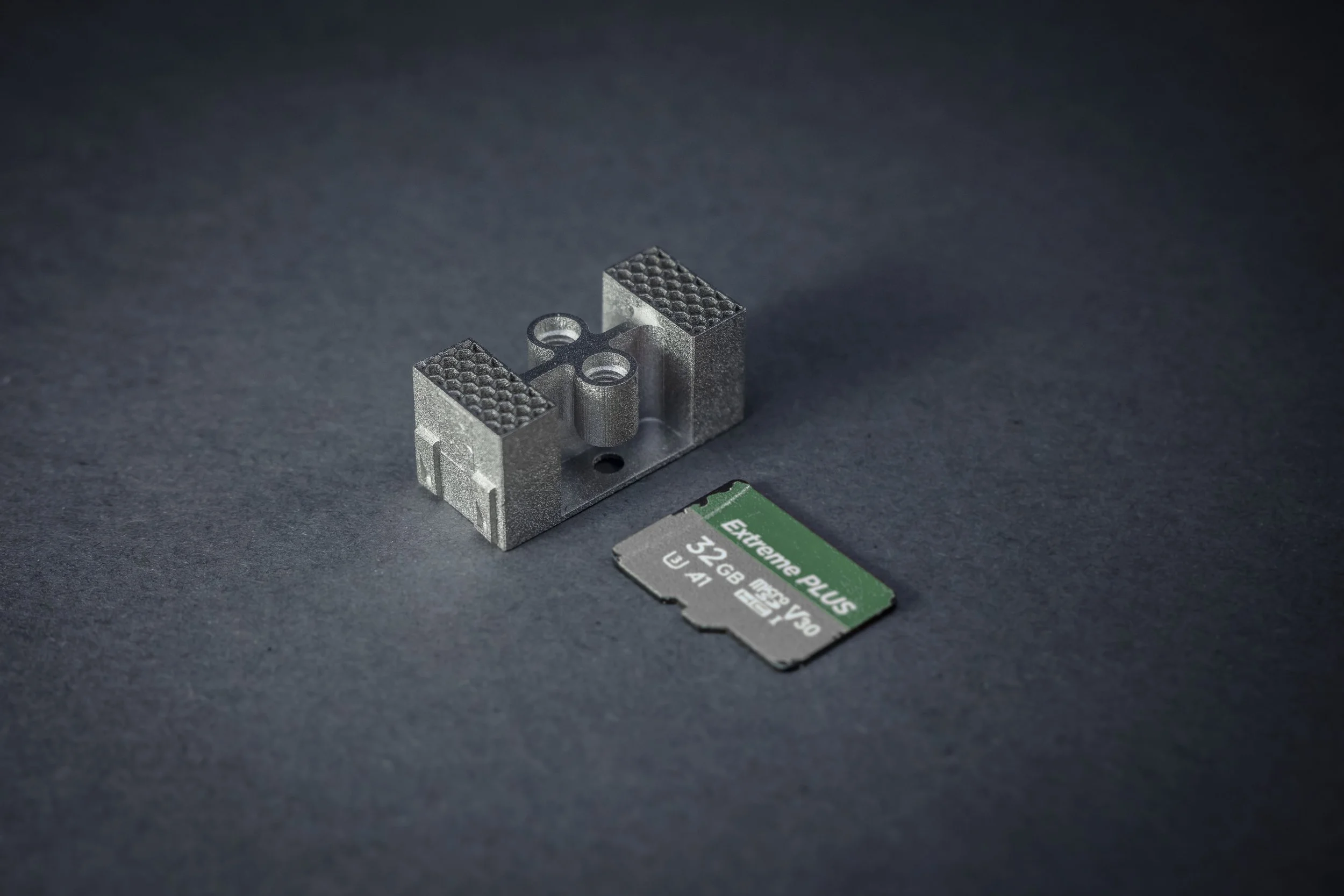
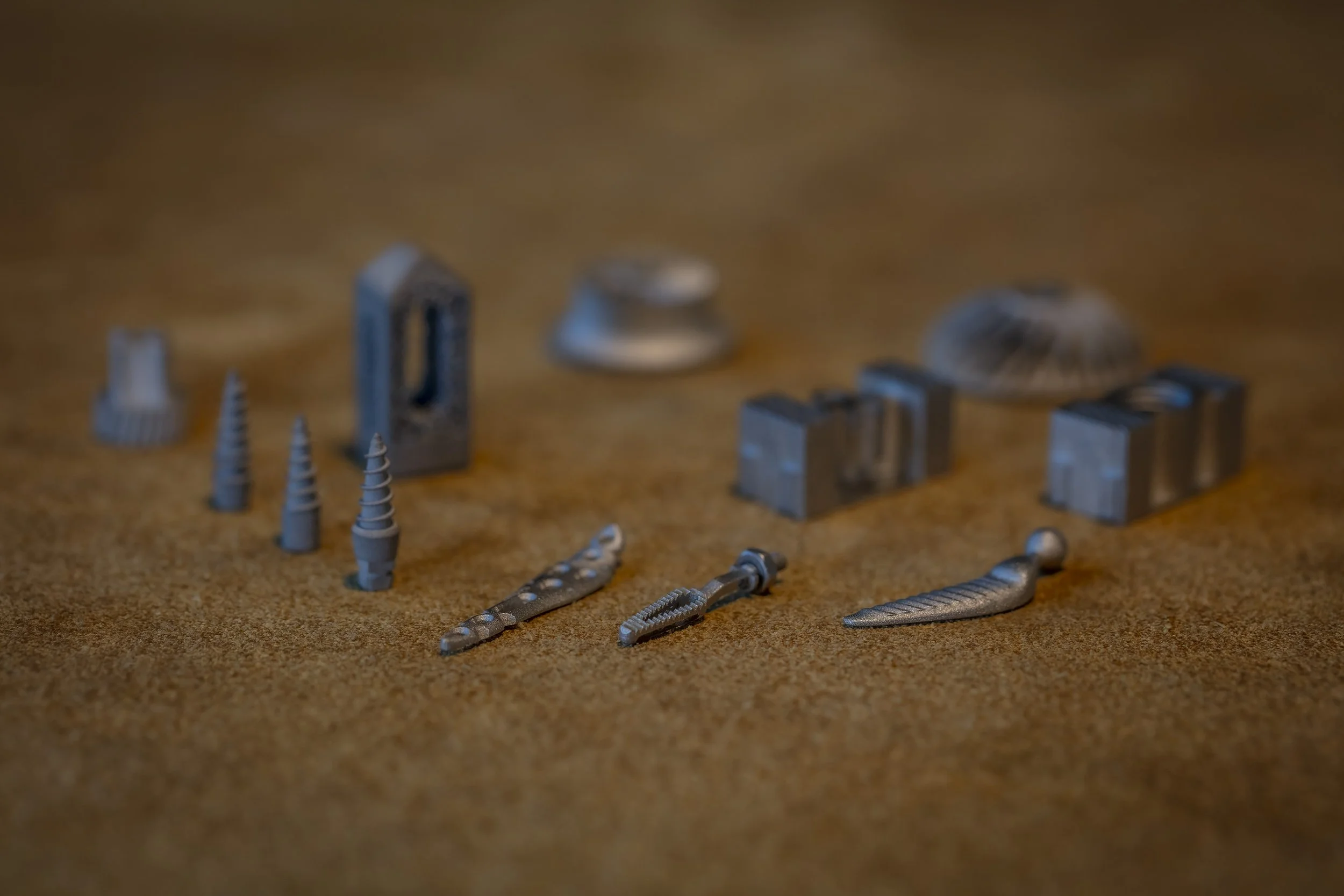
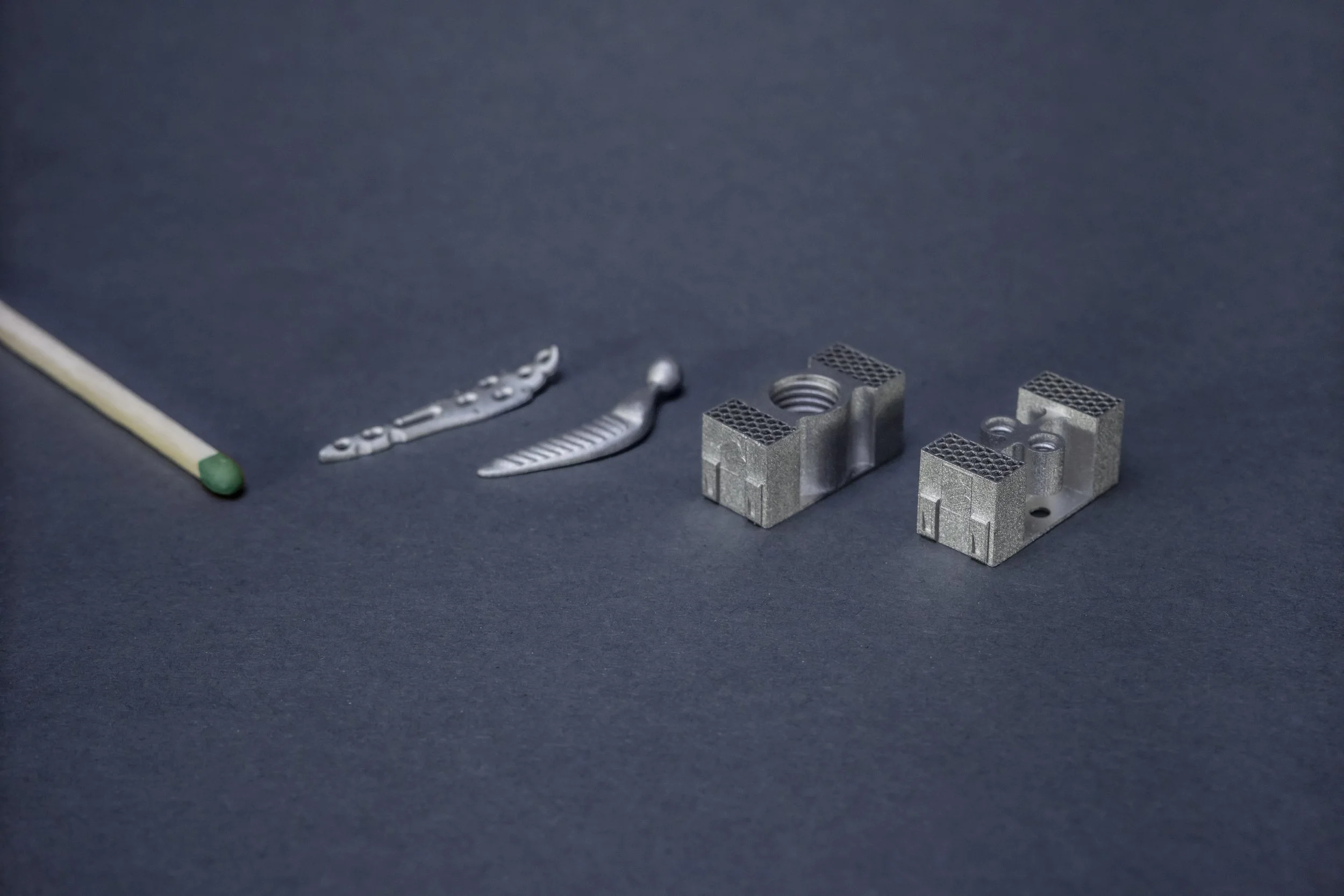
Complex 3D printed micro metal parts with fine geometries and integrated features.
The Core Challenge: Complexity in Conventional Manufacturing
In conventional metal manufacturing, part complexity directly increases process complexity. Fine geometries and integrated features cannot typically be produced in a single operation and require multiple secondary steps.
Manufacturing complex micro metal components may involve:
Multiple CNC machining operations
Micro drilling or laser processing for holes
Micro drilling or laser processing for holes
Thread cutting or forming
Engraving or embossing
Surface finishing such as grinding, polishing, or blasting
Cleaning, inspection, and handling between steps
Assembly or welding of multiple micro-components
Each step requires re-clamping, repositioning, alignment, and quality checks. When distributed across different machines or suppliers, additional logistics and coordination further increase risk and cost. The result is longer lead times, higher operational complexity, and increased potential for dimensional variation.
Tolerance Stack-Up: The Hidden Risk of Multi-Step Manufacturing
In multi-step manufacturing chains, each process introduces its own dimensional tolerance. While every individual step may meet its specification, the cumulative variation across the chain can result in measurable deviation in the final component. This phenomenon, known as tolerance stack-up, becomes particularly critical for micro metal parts where tight tolerances and functional precision are essential.
Typical sources of variation include:
Positioning deviations of the tools
Re-clamping and repositioning inaccuracies
Assembly alignment variation
Variations of the tools
As the number of steps increases, maintaining consistent dimensional control becomes increasingly difficult. In high-volume production, this often leads to:
Reduced repeatability
Increased rejection rates
Higher inspection effort
Functional performance variation
Managing complexity becomes as important as managing geometry.
Metal 3D Printing as a Solution to Manufacturing Complexity
Sinter-based metal additive manufacturing technologies offer a general solution to this challenge by consolidating geometry creation into a digitally controlled process. Instead of sequentially adding features in separate operations, many functional elements can be integrated directly into the printed part geometry, such as:
Micro holes
Internal channels
Threads
Engravings or embossings
Choosing the right method depends on multiple factors such as, material, geometrical features and quantities desired. While additive manufacturing is often advertised as “the solution” to all manufacturing challenges, some features may still require post-processing depending on tolerance requirements, surface finish needs, or functional interfaces. However, the number of required downstream operations is significantly reduced compared to conventional manufacturing.
The simplified workflow typically includes:
Metal 3D printing
Debinding and sintering
Optional post-processing if required
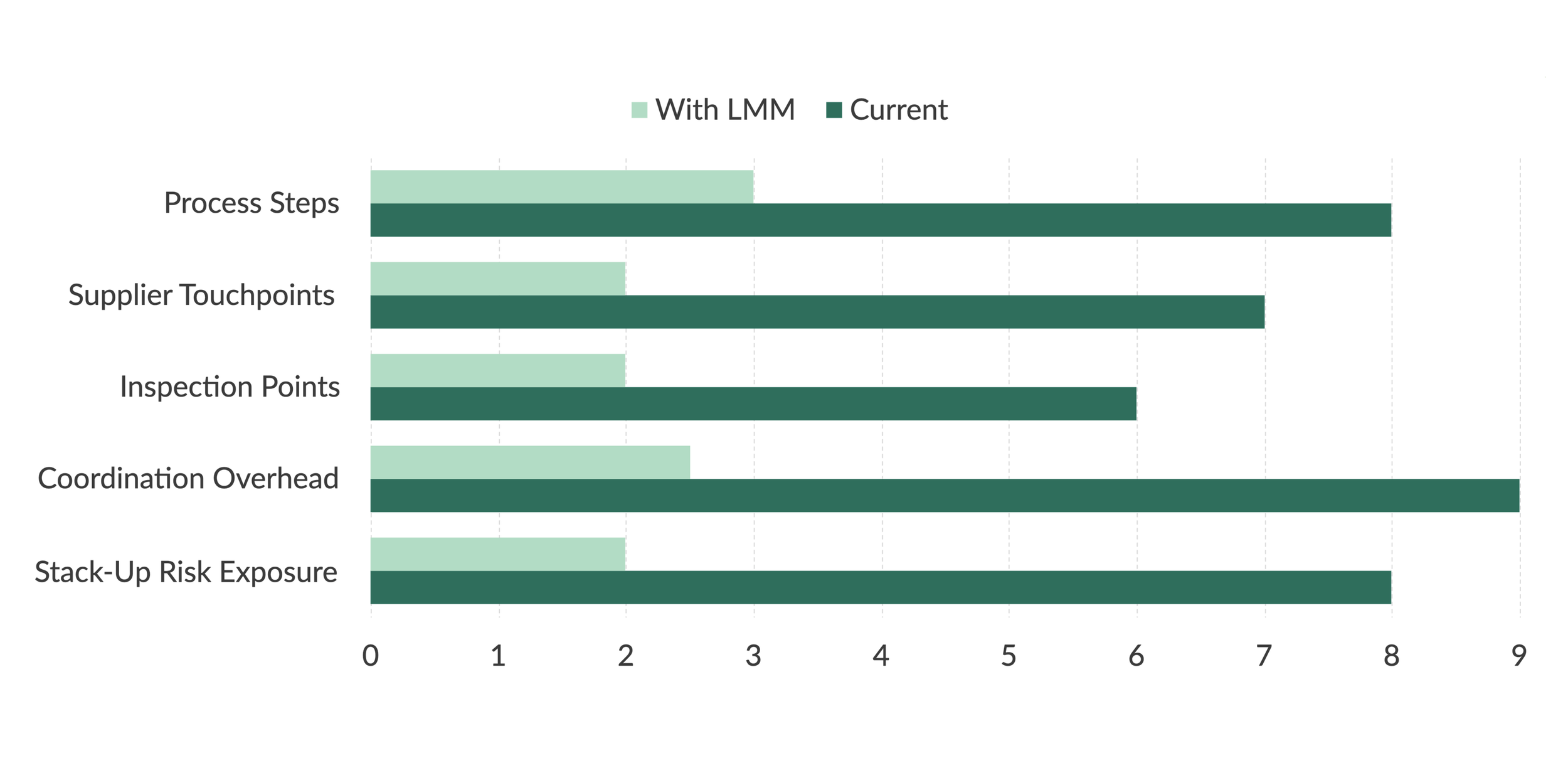
By reducing the number of independent manufacturing steps, additive manufacturing significantly lowers tolerance stack-up risk and improves dimensional consistency.
Lithography-Based Metal Manufacturing for Micro Metal Parts
Among sinter-based technologies, Lithography-based Metal Manufacturing is particularly well suited for complex micro metal components requiring high precision and fine detail resolution.
LMM uses a photopolymer-based process to build highly detailed green parts layer by layer, followed by debinding and sintering to achieve dense metal components. The technology enables excellent surface quality and fine feature resolution, making it ideal for micro-scale geometries.
For micro metal applications, LMM enables:
Fine holes and delicate internal channels
Sharp-edged engravings and embossed structures
Small threads and precision interfaces
Highly complex geometries that are difficult or impossible to machine
Because geometry is created in one coordinated digital process, dimensional control is significantly improved. In accordance with ISO 2768-1 class f, tolerances as tight as ±0.05 mm can be achieved for certain dimensions, depending on geometry and material.
While certain high-precision functional surfaces may still benefit from finishing operations, the overall manufacturing chain is dramatically simplified.
Full Process Control Enables Scalable Production
Conventional manufacturing often requires coordination across multiple process steps, machines, operators, and sometimes suppliers. Each additional step introduces interfaces that must be managed, which can increase variability, lead times, and planning complexity.
By consolidating manufacturing into a unified digital process, sinter-based metal additive manufacturing enables:
Stable dimensional accuracy across batches
Reduced manual intervention
Predictable and simplified production planning
Reduced supply chain complexity
Improved repeatability and process stability
Because multiple micro components can be produced simultaneously in controlled production batches, scaling from prototype to serial production becomes significantly more efficient. Metal 3D printing is not only a prototyping tool. It is a viable solution for serial manufacturing when complexity management and process stability are critical.
Reducing Cost, Lead Time, and Manufacturing Risk
Beyond technical simplification, manufacturing consolidation has measurable economic impact. Each additional process step introduces not only variation but also operational overhead in setup, labor allocation, coordination, logistics, and inspection.
By reducing process interfaces, additive manufacturing lowers total operational exposure across the value chain. The result is not merely fewer steps, but:
Reduced cumulative overhead cost
Shorter planning and throughput times
Lower coordination effort across suppliers or departments
Reduced systemic risk from process interruptions
Improved production predictability
In this context, complexity reduction translates directly into economic stability. Simplifying manufacturing is one of the most effective strategies for improving both economic efficiency and product quality. The use of AM enables design flexibility and freedom to change without complex machine setup allowing more freedom in manufacturing.
Validation: A Controlled Path to Manufacturing Optimization
Adopting metal 3D printing does not require abandoning established production methods. Instead, companies can validate additive manufacturing in a structured evaluation process.
This validation confirms whether additive manufacturing can achieve:
Equivalent or improved dimensional accuracy
Equivalent or improved functional performance
Reduced manufacturing complexity
Improved scalability and stability
Greater design freedom, enabling geometries that are difficult or impossible to realize with conventional manufacturing
If conventional manufacturing remains optimal, validation provides clarity. If additive manufacturing offers advantages, the result can include significant improvements in cost, risk reduction, and production scalability. This approach ensures manufacturing optimization with minimal risk.
From Prototype to Serial Production Using One Technology
In conventional manufacturing, prototype production methods often differ from serial production methods, requiring redesign, tooling adjustments, or process changes during scale-up.
Sinter-based metal additive manufacturing, including LMM, enables both prototype and serial production using the same core process. This continuity:
Accelerates development cycles
Eliminates transition risk
Ensures consistent dimensional behavior
Improves long-term production stability
For complex micro metal parts, this consistency across the product lifecycle is a significant competitive advantage.
Conclusion: Reducing Complexity as a Strategic Advantage
As micro metal components become more complex and production volumes increase, manufacturing simplicity becomes a strategic necessity. Metal 3D printing, particularly sinter-based technologies, provides a general solution to reduce manufacturing complexity, minimize risk, and consolidate process steps.
Lithography-based Metal Manufacturing extends these advantages specifically to high-precision micro metal parts, where fine detail resolution, tight tolerances, and integrated functionality are critical. In many cases, fewer manufacturing steps are not just more efficient. They are essential for achieving reliable, repeatable, and scalable production. By shifting from fragmented process chains to consolidated digital workflows, manufacturers can unlock a new level of control, stability, and scalability in micro metal production.