
Manufacturing Challenges in Micro Metal Production
When manufacturing constraints shape design, assembly, and system performance. As micro metal components evolve toward higher precision, smaller geometries, and increased functional integration, conventional manufacturing technologies are increasingly pushed to their limits. This article examines how these constraints propagate across the entire production system and how process consolidation through metal 3D printing offers a structural solution.
As micro metal components continue to evolve toward higher precision, smaller geometries, and increased functional integration, conventional manufacturing technologies are increasingly pushed to their limits. This is not a sudden disruption, but a gradual shift — driven by the growing gap between what is functionally desirable and what is practically manufacturable.
For experienced engineers, the question is rarely whether a part can be produced. Through experience, they internalize the limitations of manufacturing technologies and embed these constraints into how they think and design. Parts can often be produced with excellent accuracy, precision, and repeatability.
The real challenge lies elsewhere. Manufacturing constraints no longer only influence how parts are produced — they define how parts must be designed, how production systems are structured, and how cost, risk, and scalability behave across the entire lifecycle.
The key challenge in micro metal production is not a single process limitation. It is how multiple constraints interact across the entire manufacturing system.
Complex geometries typically require sequential operations, repeated clamping, and coordination across different machines or suppliers. Each step introduces its own variation and dependency. Over time, these dependencies form tightly coupled chains in which deviations no longer remain local — they propagate across the entire workflow.
Even when individual processes are highly capable, the system as a whole becomes increasingly sensitive, interdependent, and difficult to control.
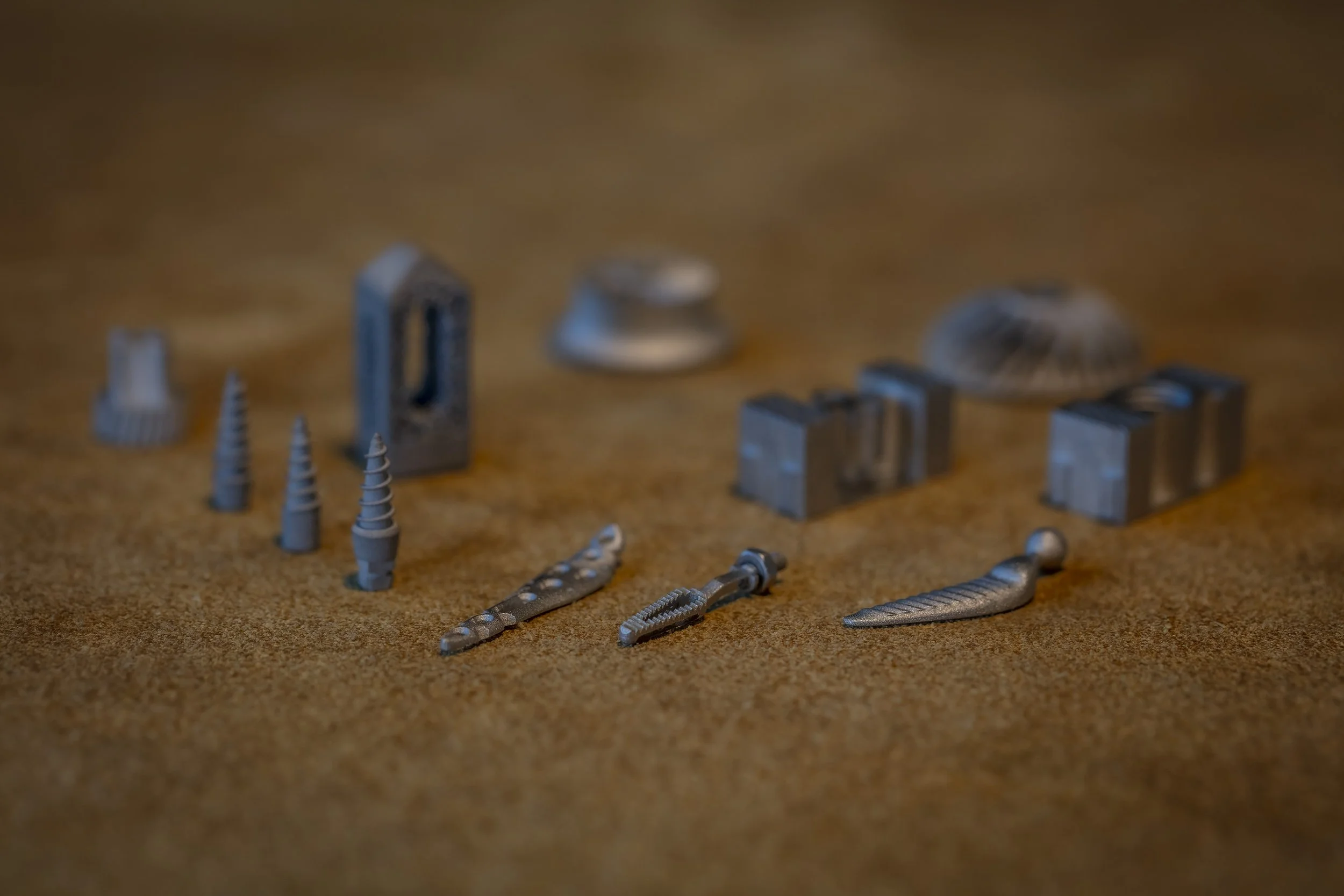
As the number of process steps increases, complexity does not grow linearly — it accumulates.
Tooling becomes more specialized, handling more sensitive, and inspection more frequent. At micro scale, even minor deviations in setup or handling can have significant impact. These effects reinforce each other across the process chain.
The result is not just increased effort, but reduced robustness. Complexity emerges gradually across the workflow, making it difficult to manage and even harder to eliminate.
Multi-step manufacturing systems are inherently fragmented. Production is distributed across machines, departments, or suppliers, and each transition introduces new dependencies.
Handovers create waiting times, scheduling constraints, and coordination challenges. Lead times become longer and less predictable, while planning effort increases significantly.
Importantly, failures in such systems rarely originate from a single process. They emerge from the interaction between processes — making them harder to trace, predict, and resolve.
When variation is introduced across multiple stages, quality control can no longer function purely as a preventive mechanism.
Inspection is repeated throughout the process chain, yet deviations often only become fully visible at the end. By that point, multiple value-adding steps have already been completed.
This leads to a structural inefficiency: errors are detected late, not because inspection is insufficient, but because variation is distributed throughout the system.
Metal additive manufacturing approaches this challenge from a different direction. Rather than optimizing individual steps, it reduces the number of steps altogether.
Geometry is created within a single, digitally controlled process. Re-clamping and repositioning are minimized, and many handovers between machines or suppliers are eliminated.
This is not just a process improvement — it is a structural change. By reducing dependencies, the manufacturing system becomes inherently more stable, and variation is less likely to accumulate across stages.
One of the most significant implications of this shift is how functional systems are realized.
In conventional manufacturing, functionality is distributed across multiple components that must be aligned and joined. In additive manufacturing, these same functions can often be integrated into a single structure. In certain cases, even moving elements can be produced directly within the same build process.
A key advantage of additive manufacturing is often underestimated: value can be created even without changing the design.
By simplifying the manufacturing system, process steps are reduced, handling and re-clamping are minimized, supplier dependencies decrease, and inspection effort can be reduced. The result is a more stable production process with lower failure rates and shorter, more predictable lead times.
These improvements are not dependent on design optimization — they arise directly from reducing system complexity.
Once manufacturing constraints are reduced, design can evolve beyond its previous limitations.
Engineers gain the ability to integrate functions, eliminate unnecessary interfaces, and optimize internal geometries in ways that were previously not feasible. Alignment between critical features can be improved, and entire assemblies can be replaced by single components.
This is where the full potential becomes visible: not just incremental gains, but a shift toward more efficient, robust, and high-performing solutions.
Additive manufacturing is not universally the better solution. Its value depends on the specific context.
A structured evaluation provides a practical starting point. Relevant factors include:
- Geometric complexity and functional requirements
- Number of process steps and involved suppliers
- Assembly structure and alignment sensitivity
- Cost, lead time, and yield behavior
- Potential for functional integration
This analysis helps determine whether value can already be realized through process consolidation — or whether redesign is required to unlock additional benefits.
In micro metal production, the central challenge is no longer achieving precision at the level of individual processes.
It is understanding how manufacturing constraints shape the entire system — from design and assembly to cost, risk, and scalability.
Conventional manufacturing provides high precision and reliability, but introduces constraints that propagate across the system. Metal 3D printing removes many of these constraints by consolidating production and enabling integration.
The shift is not incremental — it is structural:
For engineers working at the limits of micro metal production, the opportunity lies in recognizing where constraints define outcomes — and in applying the right manufacturing approach to overcome them.
Get a Free Part Evaluation
Request your sample part and evaluate LMM for your application.
Request a sample part