
Product Design Challenges in Micro Metal Components
Conventional manufacturing constrains micro metal component design through tool access and tooling limits. Design-for-manufacturing often forces engineers to simplify geometries or split parts. Additive manufacturing removes many of these constraints, enabling design based on function.
Designing micro metal components requires balancing functional performance with manufacturing feasibility. In industries such as medical devices, diagnostics, micro-mechanics, and precision engineering, components depend on extremely small geometries, tight tolerances, and complex functional features.
However, the design of many micro precision components is still heavily influenced by the limitations of conventional manufacturing processes. Engineers often adapt designs to fit the capabilities of machining, drilling, forming, or molding rather than optimizing purely for functional performance.
As components become smaller and functional requirements increase, these manufacturing constraints begin to influence product architecture itself. Features may be simplified, components divided into multiple parts, or functional elements removed entirely to ensure manufacturability. Metal additive manufacturing, particularly lithography-based metal manufacturing (LMM), enables a fundamentally different approach. By producing complex geometries within a digitally controlled process, additive manufacturing allows engineers to design micro metal parts primarily based on functional requirements rather than manufacturing limitations. This shift enables significantly greater design freedom while maintaining manufacturability at scale.
In conventional production environments, micro metal component design is shaped by the capabilities and limitations of different manufacturing approaches. These can broadly be grouped into subtractive technologies, tool-based forming processes, and additive manufacturing.
In conventional product development, design-for-manufacturing (DFM) ensures that components can be produced reliably using existing processes. However, in micro metal applications, DFM often leads to significant design compromises. Engineers may need to:
- Simplify complex functional geometries
- Remove internal channels or cavities
- Divide integrated structures into multiple parts
- Introduce additional interfaces or joining operations
These compromises influence not only component geometry but also overall product architecture. When functional units are distributed across multiple parts, alignment requirements increase and interactions between features become more sensitive to dimensional variation. As products become smaller and functional density increases, these limitations become increasingly restrictive.
When certain features cannot be produced during the primary manufacturing process, they must be introduced through secondary operations. Common secondary processes in micro metal manufacturing include:
- Micro drilling of fine holes
- Laser machining or micro cutting
- Thread cutting or forming
- Engraving or embossing
- Precision finishing operations
Each additional step introduces new dependencies between design and manufacturing planning. Engineers must consider how parts will be clamped, positioned, and accessed throughout the production chain.
In addition, secondary processes often introduce further requirements such as burr formation and removal, surface finishing, and edge conditioning. These steps are particularly critical at micro scale, where even small burrs can impact functionality or assembly.
As a result, design decisions become closely tied to the structure of the manufacturing workflow. This interaction limits the range of feasible design solutions, particularly when multiple precision features must interact within a small component.
For a deeper explanation of how multi-step production affects manufacturing complexity, see: From Complexity to Control: Scalable Micro Metal Production with Metal 3D Printing.
Maintaining dimensional alignment between features produced in separate operations is another key challenge in conventional manufacturing. Each process introduces its own variation, and these variations accumulate across the production chain. For micro precision components with tightly coupled functional features, this accumulation can affect the relative positioning of critical geometries such as holes, channels, threads, or sealing surfaces. As the number of manufacturing steps increases, maintaining predictable geometric relationships becomes more difficult. These dimensional interactions often become a central consideration during product development.
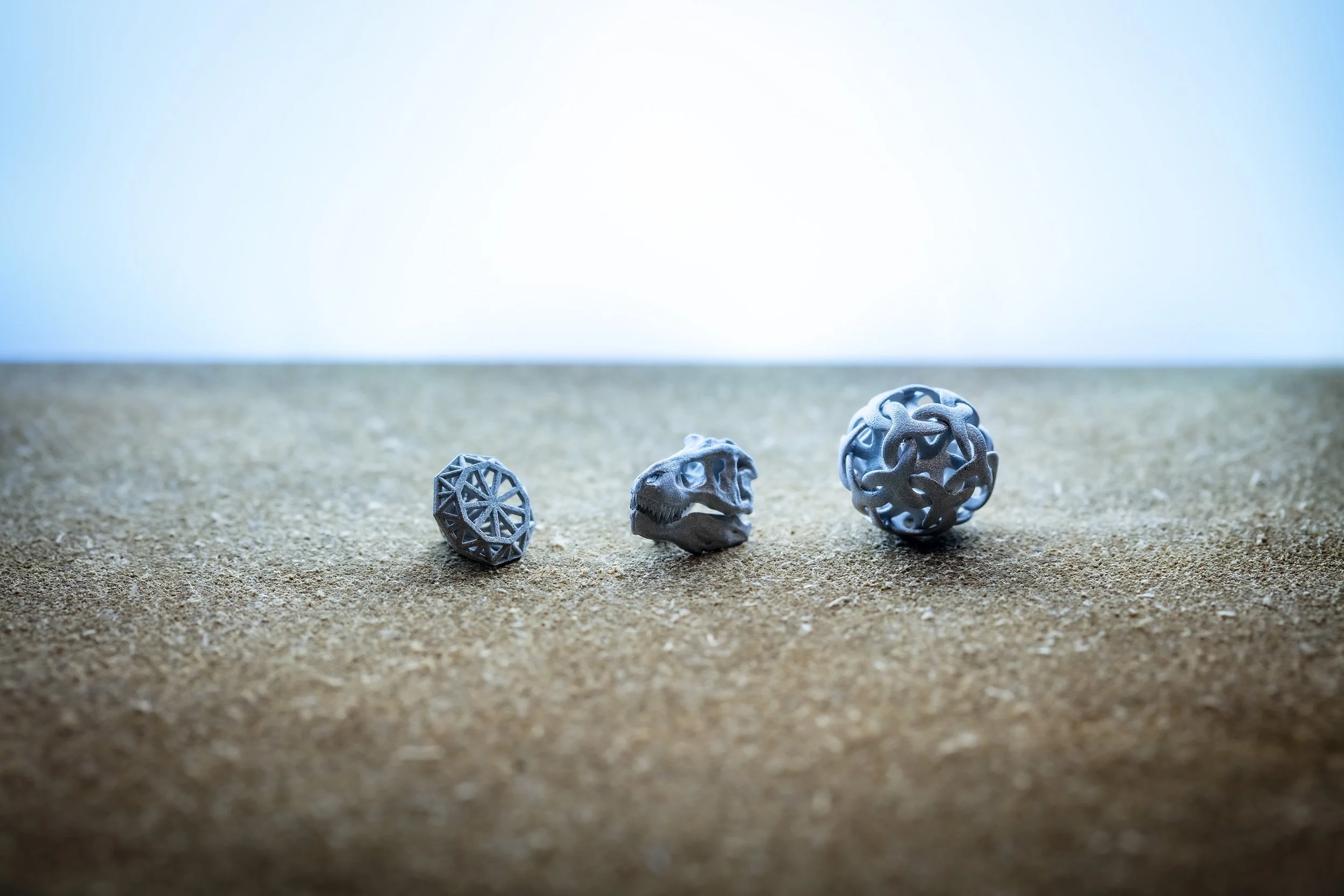
Additive manufacturing introduces a fundamentally different relationship between design and production. Lithography-based metal manufacturing builds components layer by layer within a digitally controlled photopolymerization process. Because geometry is created additively rather than through tool-based material removal or mold-based shaping, physical tool access and tooling constraints are no longer primary limitations. This enables the direct production of features that are difficult or impossible to achieve using conventional methods, including internal channels and cavities, micro holes and fine geometric features, integrated threads and interfaces, complex three-dimensional structures, functional surface patterns, and high dimensional freedom enabling seamless individualization.
Because these features are created during the primary manufacturing process, they can be integrated directly into the component rather than introduced through secondary operations. For product designers, this significantly expands the range of possible design solutions.
One of the most important advantages of additive manufacturing is the ability to integrate multiple functional features into a single component. In conventional manufacturing, complex functional units are often implemented as assemblies of multiple separately produced parts. These assemblies require alignment, joining, and quality control steps. Additive manufacturing allows many of these functional elements to be consolidated into a single high-precision metal structure. This enables engineers to:
- Reduce the number of individual components
- Simplify product architecture
- Improve alignment between interacting features
- Minimize dependency on assembly interfaces
This shift not only improves design efficiency but also reduces manufacturing complexity and potential sources of variation.
Metal 3D printing also enables the use of a consistent manufacturing process across both prototyping and serial production. In conventional environments, prototypes are often produced using different methods before transitioning to production tooling. This can introduce discrepancies between prototype performance and final production parts. Lithography-based metal manufacturing allows engineers to produce production-equivalent components early in development. Functional validation can therefore be performed using parts manufactured with the same process intended for series production, reducing risk during scale-up.
As product miniaturization continues and functional requirements increase, the limitations of traditional manufacturing processes become more pronounced. Subtractive and tool-based forming methods will continue to play an important role in manufacturing, but their constraints increasingly shape product design at micro scale. Additive manufacturing, by contrast, removes many of these limitations. Complex geometries can be produced directly within a single, digitally controlled process, without dependence on tool access or dedicated tooling.
At the same time, designing for lithography-based metal manufacturing introduces its own considerations. Engineers must understand process-specific factors such as material behavior, support strategies, and sintering-related dimensional changes. In many cases, existing designs need to be adapted or rethought to fully leverage the advantages of additive manufacturing. This makes early design collaboration essential. Rather than simply transferring conventional designs into a new process, the greatest value is achieved when components are intentionally designed for additive manufacturing.
As a result, metal additive manufacturing is not only a new production method, but an enabler of a new design philosophy — one in which product architecture is increasingly defined by function rather than manufacturing limitations, while still requiring a deep understanding of process-specific design principles.
Get a Free Part Evaluation
Request your sample part and evaluate LMM for your application.
Request a sample partHow Manufacturing Constraints Limit Design and How Metal 3D Printing Enables Design Freedom
Designing micro metal components requires balancing functional performance with manufacturing feasibility. In industries such as medical devices, diagnostics, micro-mechanics, and precision engineering, components depend on extremely small geometries, tight tolerances, and complex functional features.
However, the design of many micro precision components is still heavily influenced by the limitations of conventional manufacturing processes. Engineers often adapt designs to fit the capabilities of machining, drilling, forming, or molding rather than optimizing purely for functional performance.
As components become smaller and functional requirements increase, these manufacturing constraints begin to influence product architecture itself. Features may be simplified, components divided into multiple parts, or functional elements removed entirely to ensure manufacturability. Metal additive manufacturing, particularly lithography-based metal manufacturing (LMM), enables a fundamentally different approach. By producing complex geometries within a digitally controlled process, additive manufacturing allows engineers to design micro metal parts primarily based on functional requirements rather than manufacturing limitations. This shift enables significantly greater design freedom while maintaining manufacturability at scale.
What Limits Micro Metal Part Design in Conventional Manufacturing?
In conventional production environments, micro metal component design is shaped by the capabilities and limitations of different manufacturing approaches. These can broadly be grouped into subtractive technologies, tool-based forming processes, and additive manufacturing.
Subtractive Manufacturing: Geometry Limited by Tool Access
Subtractive technologies, such as CNC machining, turning, and micro drilling, create geometry by removing material using cutting tools that must physically access the surfaces being produced. At micro scale, these constraints become particularly restrictive. Internal features, deep or narrow cavities, and complex three-dimensional geometries are often difficult or impossible to manufacture directly. Minimum tool diameters limit feature resolution, while tool reach restricts access to internal structures. Fully enclosed channels and undercuts typically require additional steps or cannot be produced at all.
While these limitations can often be managed for larger components, they become significantly more restrictive at micro scale. Engineers frequently adjust component geometry to ensure tool accessibility, simplifying internal channels, opening cavities, or redesigning complex features. In many cases, designs are split into multiple parts to enable manufacturing, requiring additional joining processes such as welding, brazing, or other assembly technologies. Over time, these adaptations can influence the entire product architecture. The final design often reflects manufacturing constraints as much as functional requirements.
Tool-Based Forming: Constraints Defined by Molds and Tooling
Tool-based forming processes, such as casting and metal injection molding (MIM), shape components using molds or dies. While these methods can support high-volume production, they introduce their own set of geometric limitations. Designs must accommodate mold fabrication, material flow, and part ejection. This restricts undercuts, internal cavities, and fine feature detail. At micro scale, achieving high precision in small, complex geometries becomes increasingly challenging due to tooling limitations and process variability.
In addition, tooling introduces process dependencies beyond shaping itself. Tool fabrication, maintenance, and part removal (demolding or ejection) must all be considered during design. These constraints reduce flexibility and often require engineers to adapt designs to align with tooling limitations rather than purely functional requirements.
Design for Manufacturing vs Design for Function
In conventional product development, design-for-manufacturing (DFM) ensures that components can be produced reliably using existing processes. However, in micro metal applications, DFM often leads to significant design compromises. Engineers may need to:
Simplify complex functional geometries
Remove internal channels or cavities
Divide integrated structures into multiple parts
Introduce additional interfaces or joining operations
These compromises influence not only component geometry but also overall product architecture. When functional units are distributed across multiple parts, alignment requirements increase and interactions between features become more sensitive to dimensional variation. As products become smaller and functional density increases, these limitations become increasingly restrictive.
Secondary Manufacturing Operations and Their Impact on Design
When certain features cannot be produced during the primary manufacturing process, they must be introduced through secondary operations. Common secondary processes in micro metal manufacturing include:
Micro drilling of fine holes
Laser machining or micro cutting
Thread cutting or forming
Engraving or embossing
Precision finishing operations
Each additional step introduces new dependencies between design and manufacturing planning. Engineers must consider how parts will be clamped, positioned, and accessed throughout the production chain.
In addition, secondary processes often introduce further requirements such as burr formation and removal, surface finishing, and edge conditioning. These steps are particularly critical at micro scale, where even small burrs can impact functionality or assembly.
For processes involving tooling, additional considerations include tool fabrication, wear, and the handling of parts during insertion and removal from tools or fixtures.
As a result, design decisions become closely tied to the structure of the manufacturing workflow. This interaction limits the range of feasible design solutions, particularly when multiple precision features must interact within a small component.
For a deeper explanation of how multi-step production affects manufacturing complexity, see: From Complexity to Control: Scalable Micro Metal Production with Metal 3D Printing.
Dimensional Alignment and Tolerance Interaction
Maintaining dimensional alignment between features produced in separate operations is another key challenge in conventional manufacturing. Each process introduces its own variation, and these variations accumulate across the production chain. For micro precision components with tightly coupled functional features, this accumulation can affect the relative positioning of critical geometries such as holes, channels, threads, or sealing surfaces. As the number of manufacturing steps increases, maintaining predictable geometric relationships becomes more difficult. These dimensional interactions often become a central consideration during product development.
Metal 3D Printing Enables a Different Design Approach
Additive manufacturing introduces a fundamentally different relationship between design and production. Lithography-based metal manufacturing builds components layer by layer within a digitally controlled photopolymerization process. Because geometry is created additively rather than through tool-based material removal or mold-based shaping, physical tool access and tooling constraints are no longer primary limitations. This enables the direct production of features that are difficult or impossible to achieve using conventional methods, including:
Internal channels and cavities
Micro holes and fine geometric features
Integrated threads and interfaces
Complex three-dimensional structures
Functional surface patterns
High dimensional freedom enabling seamless individualization
Because these features are created during the primary manufacturing process, they can be integrated directly into the component rather than introduced through secondary operations. For product designers, this significantly expands the range of possible design solutions.
Functional Integration in Micro Metal Components
One of the most important advantages of additive manufacturing is the ability to integrate multiple functional features into a single component. In conventional manufacturing, complex functional units are often implemented as assemblies of multiple separately produced parts. These assemblies require alignment, joining, and quality control steps. Additive manufacturing allows many of these functional elements to be consolidated into a single high-precision metal structure. This enables engineers to:
Reduce the number of individual components
Simplify product architecture
Improve alignment between interacting features
Minimize dependency on assembly interfaces
This shift not only improves design efficiency but also reduces manufacturing complexity and potential sources of variation.
For a deeper discussion of how functional integration influences manufacturing cost and assembly complexity, see: Reducing Cost per Part for Complex Micro Metal Components.
Supporting Both Prototyping and Serial Production
Metal 3D printing also enables the use of a consistent manufacturing process across both prototyping and serial production. In conventional environments, prototypes are often produced using different methods before transitioning to production tooling. This can introduce discrepancies between prototype performance and final production parts. Lithography-based metal manufacturing allows engineers to produce production-equivalent components early in development. Functional validation can therefore be performed using parts manufactured with the same process intended for series production, reducing risk during scale-up.
For more information on structured validation when adopting new manufacturing technologies, see: De-Risking Micro Metal Manufacturing Through Structured Validation.
Designing Micro Metal Components for Future Manufacturing
As product miniaturization continues and functional requirements increase, the limitations of traditional manufacturing processes become more pronounced. Subtractive and tool-based forming methods will continue to play an important role in manufacturing, but their constraints increasingly shape product design at micro scale. Additive manufacturing, by contrast, removes many of these limitations. Complex geometries can be produced directly within a single, digitally controlled process, without dependence on tool access or dedicated tooling.
At the same time, designing for lithography-based metal manufacturing introduces its own considerations. Engineers must understand process-specific factors such as material behavior, support strategies, and sintering-related dimensional changes. In many cases, existing designs need to be adapted or rethought to fully leverage the advantages of additive manufacturing. This makes early design collaboration essential. Rather than simply transferring conventional designs into a new process, the greatest value is achieved when components are intentionally designed for additive manufacturing.
As a result, metal additive manufacturing is not only a new production method, but an enabler of a new design philosophy—one in which product architecture is increasingly defined by function rather than manufacturing limitations, while still requiring a deep understanding of process-specific design principles.
